

Managed inference is the right call for scaling teams that want to deploy models rapidly without the massive overhead of managing their own infrastructure. But choosing the right architecture means matching your latency requirements, configuration needs, and billing structure to how your product actually runs.
This post gives you a clear decision framework for choosing between managed inference options — serverless, dedicated, Elastic Endpoints, and batch — based on three variables: latency requirements, traffic patterns, and whether your workload needs capabilities that only a dedicated endpoint can provide.
Four managed inference options
Before running through the decision logic, let’s establish what managed inference modes exist and how they compare across workload variables:
How to select the right mode of managed inference
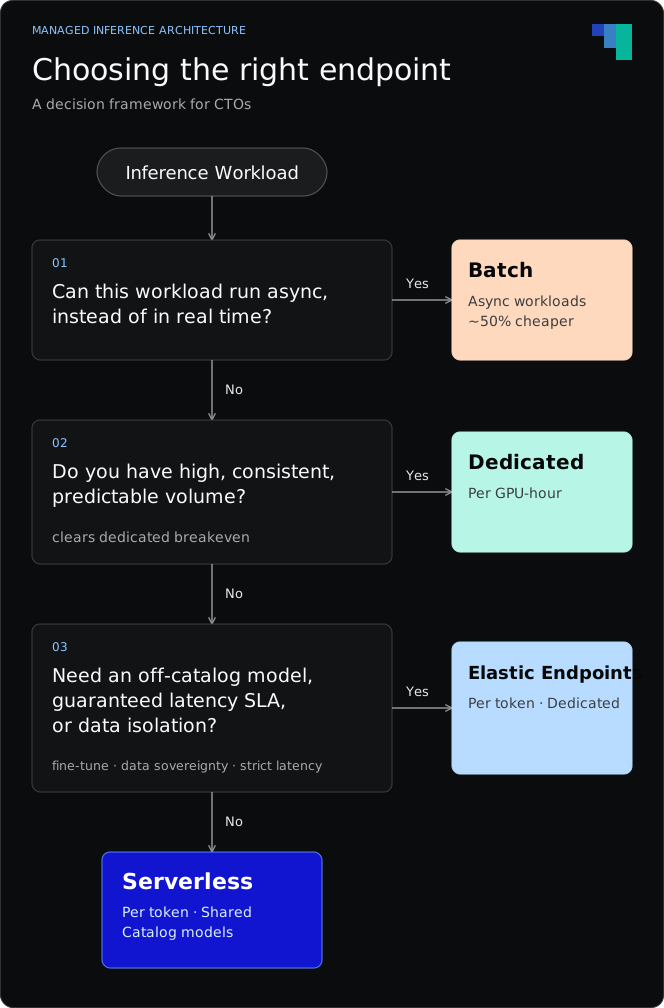
Architecting your inference comes down to three questions:
- Latency requirements - Are you handling user requests in real-time?
- Traffic volume and utilization - Do you have consistent or spiky traffic patterns?
- Configuration capability - Do you need a specific model or have strict SLA requirements?
Each one either resolves the decision or passes it to the next question.
Latency requirements: Real-time vs. async workloads
When choosing the right inference mode for your workload, start by assessing your latency requirements: Is a live user waiting on a response on the other end?
This separates the real-time workloads (like chatbots, copilots, live assistants, agents) from async tasks like document processing, background classification, embeddings, and fraud detection.
For async requests: With these workloads, latency variance costs you nothing, so why pay a real-time premium? Batch’s discounted pricing makes it the right answer almost every time. Let’s take Parasail’s batch inference pricing as an example:
Qwen3.5-397B-A17B via Serverless costs $3.60/MTok output. The same model via Batch costs $1.80/MTok. That’s a 50% discount right out of the box, before any additional optimization.
Shifting high-volume async workloads to batch reduces load on real-time inference and improves your utilization economics.
For real-time requests: You need a real-time capable endpoint. For most managed inference providers that means dedicated or serverless. On Parasail, Elastic Endpoints are also an option. The next question you need to ask yourself: is per-token pricing or GPU-hour billing a more viable option? And to determine that you need to take a look at your traffic shape.
Traffic volume & utilization: Pay-per-token vs GPU-hour pricing models
For real-time workloads, your traffic pattern determines whether pay-per-token or pay-per-GPU-hour billing makes sense for your cost structure.
Most serverless providers charge a premium for per-token pricing to hedge against underutilized capacity. When you move to dedicated GPU-hour billing, you pay a fixed rate whether the hardware is processing requests or not. If traffic is inconsistent or cyclical, you’ll burn cash on idle compute and eat the inefficiency yourself.
At what traffic volume is dedicated GPU pricing cheaper?
The honest answer is there's no universal threshold. Any vendor who gives you a simple utilization percentage is optimizing for their own sales motion, not your cost structure.
‘Utilization’ itself is not a single number, but an aggregate pattern of independent and dependent variables. That makes it impossible to cleanly capture the breakeven point with any single formula.
The actual economics of utilization depend on:
- Model size determines the minimum hardware required. A 1T parameter model needs a fundamentally different GPU configuration than an 8B model.
- Hardware generation choice trades cost against throughput. Higher generation means faster inference but higher hourly cost.
- Per-stream vs. aggregate throughput move in opposite directions as batch size increases. Per-stream throughput answers "is this fast enough for my user?" Aggregate throughput answers "can this handle my traffic volume?" Optimizing one degrades the other.
- Performance envelope limits viable batch sizes. If you have a latency SLA, your batch sizes are constrained, aggregate throughput is capped, and the cost economics change.
- Traffic pattern volatility means monthly averages aren’t representative of actual utilization. A product with 90% of traffic during business hours can look well-utilized on paper while paying for hours of idle capacity overnight.
- Provisioning buffer requirements add real cost and more instances than you’d expect. You have to spin up a new instance before utilization hits 100% because by the time you're there, you're already violating your throughput SLA. If your latency SLA caps utilization at 60% per instance to guarantee acceptable per-stream performance, then you're spinning up a second instance when the first is a little over halfway full.
- KV cache dynamics further muddy the math. Cache hit rates vary by workload, prefix reuse affects realized throughput, and both shift your effective cost per token in ways that aren't predictable upfront.
The math can give you an estimate, but without real usage data you can’t accurately predict when GPU pricing beats per-token for your workload.
Our recommendation: Start on per-token Elastic Endpoints and run them for a representative period (a week, a month, however your business cycles) then compare with the equivalent dedicated GPU-hour cost would’ve been for the same period. Making a comparison based on your actual traffic data is the only reliable way to know whether pay-per-token or GPU-hour inference wins for your workload.
Configuration capability: When to switch from a serverless API to dedicated GPU
If you've reached this point, you’re handling real-time traffic but without the consistent volume that makes always-on GPU-hour billing feasible. The question now is whether you need capabilities that only a dedicated endpoint provides.
These are the most common triggers that push teams to switch from an open-source API to a dedicated GPU:
- You want a model that isn't in the public catalog. Serverless platforms host popular open-weights models, but don’t host niche models, domain-specific models, or models that you’ve fine-tuned on your own data.
- Shared compute goes against compliance. GDPR, HIPAA, financial data regulations, enterprise customer contracts, any of these can mean that multi-tenant inference creates real legal or contractual exposure.
- You need SLA guarantees. Serverless runs on shared capacity, which means your p95 is subject to pool load and server location and KV cache utilization are out of your control. If you've committed to a strict SLA, shared compute can't back it up.
If you're on catalog models, latency variance is acceptable, and you have no compliance or SLA requirements, serverless is the best option.
If you need any of these guarantees, a dedicated endpoint is necessary. It gives you control over model selection, GPU and data location, and the ability to achieve strict SLAs. If your traffic doesn't sustain always-on GPU-hour billing, Elastic Endpoints give you a dedicated endpoint with per-token billing that doesn't charge you for idle time.
Parasail's take on managed inference
Most of the managed inference market was built on static compute, rigid capacity contracts, and a pricing model that shifts idle GPU risk to the customer. When demand spikes unexpectedly, you queue or throttle. Dedicated endpoints mean locking in to 6 to 12 month contracts. Scaling new capacity can take months in a supply environment that is chronically outpaced by demand.
Parasail was built around three convictions the rest of the market hasn't caught up to:
You should commit to token spend, not hardware. Our drawdown contracts are denominated in tokens, not GPU hours. As your workload shifts to accommodate new models, changing traffic patterns, or rapid growth, your contract moves with you.
Dedicated endpoints shouldn't require paying for idle time. Elastic Endpoints give you a reserved endpoint with per-token pricing. No other major managed inference provider offers this combination. You get SLA guarantees and data isolation without paying for GPUs sitting idle.
Performance optimization shouldn't be a negotiation. Parasail applies advanced kernel work across the fleet, including licensed partner kernels for Kimi and Qwen models, speculative decoding, and per-model tuning. We don't quantize models unless you ask us to. No benchmark games or silent degradation.
Need help scoping your deployment?
Whether you're moving off a self-hosted prototype, scaling past what serverless can handle, or looking for a dedicated endpoint without the overhead of a long-term GPU contract, Parasail has a managed inference option that fits. Contact us to learn more.


